She’s Not Angry. She’s Exhausted.
- |
- 27 Oct 2026
- |
- Women’s Wellbeing

This Diwali, let’s look beyond her irritation and recognise the invisible weight she carries.
“Why are you so irritated?”
“What’s wrong with you?”
“At least during festivals, you could be a little happier.”
We have heard these questions in our homes, perhaps even asked them ourselves. Often, we ask them without realising that the woman on the receiving end might already be struggling to hold herself together.
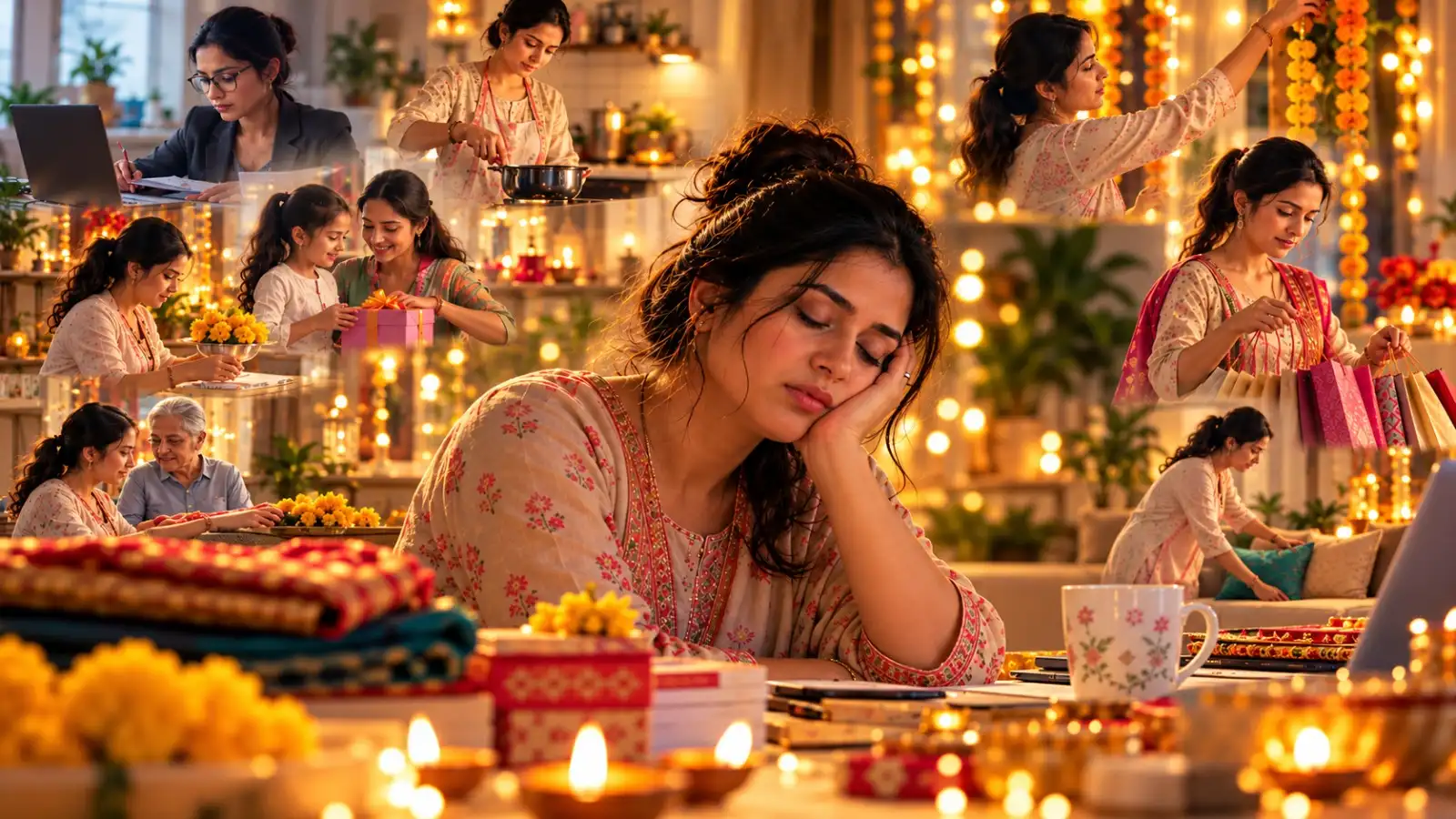
Think about the days leading up to Diwali. The house needs cleaning, groceries need to be bought, gifts need to be arranged, sweets need to be prepared, children need attention, and relatives need to be welcomed. There are clothes to choose, rituals to organise, meals to plan, and a hundred little things that someone must remember.
And very often, that someone is a woman.
She might have spent eight hours at work before returning home to begin another shift. She might be managing her children’s schedules, checking on ageing parents, supporting her partner, and ensuring that everyone has what they need. Somewhere in between, she is also expected to look good, dress up, smile for photographs, and make sure everyone enjoys the festival.
Then, when she finally loses her patience over something seemingly insignificant, we call her angry.
But what if she isn’t angry?
What if she is simply exhausted?
The invisible labour behind the celebration
Indian festivals are beautiful because they bring families together. They give us an opportunity to reconnect, celebrate traditions, and create memories. But behind many of these celebrations lies an enormous amount of work that often goes unnoticed.
This is what we often call the Cognitive Load – the invisible responsibility of planning, remembering, anticipating, and managing the needs of others. Even when she sits down, her mind may continue working.
Her body might be resting, but her mind is still running. And when this continues for days, emotional exhaustion can begin to show up as irritability, impatience, or the need to withdraw.
Unfortunately, we often notice the moment she snaps but overlook everything that happened before it. We hear her raised voice but miss the exhaustion behind it. We notice her reaction but rarely examine the expectations that may have contributed to it.
Perhaps it is time we stopped asking why women cannot manage everything gracefully and started asking why they are expected to manage everything in the first place.
Her body has a story, too
There is another dimension to this conversation that deserves our attention – Women’s physical and hormonal health.
A woman’s emotional well-being does not exist separately from her body. Sleep deprivation, chronic stress, menstrual symptoms, and hormonal transitions can all influence how she feels and responds to everyday situations.
For some women, the days before menstruation bring changes in mood, energy, sleep, or emotional sensitivity. For others, perimenopause may involve disrupted sleep, hot flashes, mood changes, and difficulty concentrating.
These experiences vary from person to person. Not every emotional response is hormonal, and not every woman experiences the same symptoms.
Yet women are often expected to function at the same pace regardless of what their bodies are going through.
Imagine experiencing physical discomfort, sleeping poorly, managing a demanding job, and handling the additional responsibilities of a festival. Now add the expectation that you must remain patient, cheerful, accommodating, and emotionally available to everyone around you.
It is a lot to ask of anyone.
Instead of saying, “You are always in a bad mood,” perhaps we could ask, “Have you been getting enough rest?” Instead of dismissing her frustration, we could ask whether she is feeling physically comfortable or needs support.
Sometimes, the answer may be medical attention. Sometimes, it may be emotional support. And sometimes, it may simply be a more equal distribution of responsibilities. The first step is to stop assuming and start listening.
The pressure to be happy
Festivals come with an emotional expectation of their own.
Diwali is supposed to be joyful. Families are supposed to be happy. Homes are supposed to be full of laughter, and women are often expected to help create that atmosphere.
They are expected not only to participate in the celebrations but also to ensure that everyone else enjoys them. And through all of this, she must remain calm. But happiness cannot be assigned like a household chore.
We must stop treating a woman’s exhaustion as evidence that she is ungrateful or that she does not care about her family. Sometimes, the people who care the most are the ones who have forgotten to care for themselves.
And sometimes, they have been doing so for years.
When exhaustion starts looking like anger
When someone repeatedly ignores their own needs, sacrifices sleep, pushes through physical discomfort, and takes responsibility for everyone around them, their emotional reserves can become depleted. Eventually, even a small request can feel overwhelming.
A misplaced object, a last-minute demand, an unanswered question, or someone asking, “What’s for dinner?” may become the final straw.
This does not mean that exhaustion excuses hurtful behaviour. We are all responsible for how we treat others. But understanding the circumstances behind a reaction allows us to respond with empathy rather than immediate judgement.
Instead of asking, “Why are you always so angry?”, we could ask, “What has been feeling overwhelming lately?”
Instead of saying, “You are making a big deal out of everything,” we could say, “Tell me what I can take off your plate.”
There is a difference between offering help and sharing responsibility. Real support means recognising that the home belongs to everyone who lives in it. The responsibility for making a festival beautiful should never rest on one person’s shoulders.
This Diwali, give her the freedom to rest
We often express love during festivals through gifts, jewellery, clothes, sweets, and thoughtful surprises. These gestures matter. But perhaps this year, we can offer women something equally meaningful: the freedom to not do everything alone.
Let someone else take charge of the preparations. Share household responsibilities without waiting to be asked. Allow the food to be simpler and the decorations to be fewer. Accept that not everything needs to be perfect.
Ask her what she wants instead of assuming what she should be doing. And if she says she wants to sit quietly, let her. Do not interpret her silence as disrespect, her tiredness as laziness, or her need for space as rejection.
She is not necessarily angry. She may be tired of carrying more than her share, tired of being the person everyone depends on, and tired of having her exhaustion misunderstood.
This Diwali, before we judge her reaction, let us look at the weight she has been carrying. Let her experience the festival as a participant, not merely as the person responsible for making it enjoyable for everyone else.
She, too, deserves to sit among the lights, enjoy the sweets, laugh with her family, and experience the warmth of the celebration without mentally checking off an endless list of unfinished tasks. She deserves to be cared for without having to organise her own care.
Before we ask her to smile, let us ask her if she is okay.
And before we celebrate the festival of lights, let us make sure the women who bring warmth into our homes are not left running on empty.






Supriya Gautam
27 Oct 2026, 10:19 PMWhat a wonderful write up!! Every word resonates with me so much.