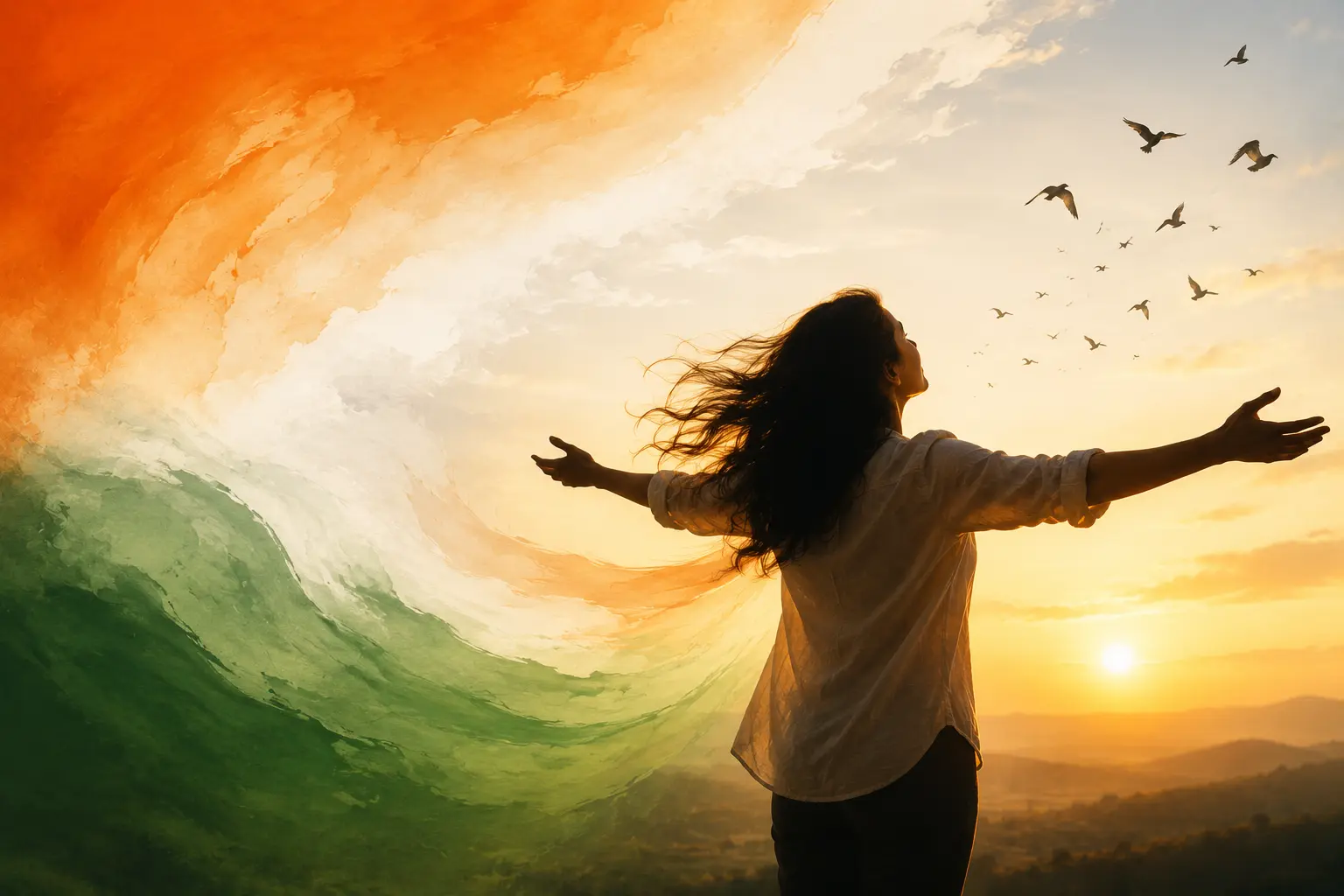
True Freedom Is the Freedom to Express What You Feel.
- |
- 14 Aug 2026
- |
- Mental Health

This Independence Day, let’s talk about a freedom we often forget – emotional freedom.
Every year on Independence Day, we celebrate the freedom of our nation. We remember the people who fought for it. We celebrate the right to live freely, make our own choices, speak our minds, and build our lives with dignity.
But as we celebrate the freedom we have inherited, perhaps it is also worth asking ourselves a quieter question:
Are we truly free within ourselves?
Can we express what we feel without fear of being judged?
Can we say, “I am struggling,” without feeling ashamed?
Can we cry without being told to be strong?
Can we admit that we are tired, angry, lonely, confused, or hurt without immediately being asked to “think positive”?
On this Independence Day, as we celebrate the freedom of our nation, let us also reflect on another kind of freedom – the freedom within. The freedom to express our emotions, acknowledge our struggles, and ask for support without fear or shame. Because a person can be free in the world and still feel imprisoned inside their own thoughts and emotions. And sometimes, those invisible prisons are built not by others, but by the emotions we have spent years suppressing.
True freedom is not just having the right to speak. True freedom is having the courage and safety to express what your heart carries.
What Is the Opposite of Depression?
Ask someone, “What is the opposite of depression?”
Most people will probably say happiness, cheerfulness, positivity, or joy.
But perhaps we need to look at it differently.
What if the opposite of depression is not happiness, but expression?
Not because expressing emotions magically eliminates depression, or because every depressed person simply needs to “talk about it.” Depression is a complex mental health condition that can have many contributing factors and often requires professional support.
But there is something deeply important about having the freedom and safety to express what is happening inside us because when emotions have nowhere to go, we often end up carrying them alone.
The Emotions We Learn to Hide
Think about how early we learn to suppress ourselves.
A little boy falls down and cries. “Boys don’t cry. Be strong.”
A girl gets angry. “Good girls don’t behave like this.”
A teenager says they are overwhelmed. “Everyone goes through this. You’ll be fine.”
An adult says they are exhausted. “You have a good job, a family, a house. What more do you want?”
And slowly, we learn a dangerous lesson – ‘Some emotions are acceptable. Others are not.’
So we learn to hide. We hide our anger because we don’t want to seem difficult. We hide our sadness because we don’t want to become a burden. We hide our fear because we want to appear strong. We hide our loneliness because admitting it feels embarrassing. We hide our disappointment because we are told to be grateful. And eventually, we may become so good at hiding our emotions that even we stop knowing what we are feeling.
What We Suppress Doesn’t Simply Disappear
An emotion that is not expressed does not necessarily disappear. Sometimes it gets pushed deeper. The anger we never acknowledged may show up as irritability. The grief we never processed may remain as heaviness. The fear we never talked about may become constant worry. The loneliness we kept denying may become disconnection. The exhaustion we ignored may eventually make even ordinary things feel overwhelming.
Our emotions are not enemies. They are information. They tell us something about our experiences, our boundaries, our needs, our losses, and our relationships.
The question is not always, “How do I get rid of this feeling?” Sometimes the more useful question is: “What is this feeling trying to tell me?”
Expression Is Not the Same as Losing Control
There is a misconception that expressing emotions means becoming dramatic, angry, or emotionally dependent on others. It doesn’t.
Healthy expression can be as simple as saying:
“That hurt me.”
“I am not okay today.”
“I need some time.”
“I am angry, and I need to understand why.”
“I don’t know what I’m feeling right now, but something doesn’t feel right.”
“I need help.”
These are not statements of weakness. They are statements of self-awareness. It takes courage to acknowledge what is happening inside you, especially in a culture where being “strong” is often valued more than being honest.
Expression Can Take Many Forms
Not everyone expresses themselves by talking. Sometimes expression is writing the words you cannot say. Sometimes it is crying after years of holding everything together. Sometimes it is creating art. Sometimes it is music. Sometimes it is sitting quietly and allowing yourself to feel. Sometimes it is telling a trusted friend, “I don’t need advice right now. I just need you to listen.” And sometimes, expression means sitting with a mental health professional and finally saying the things you have never been able to say anywhere else.
Expression is not about telling everyone everything. It is about having at least one safe space where you don’t have to pretend.
The Freedom to Say “I Need Help”
Perhaps one of the most important forms of emotional freedom is the freedom to ask for help. We often wait until things become unbearable before reaching out. Why? Because somewhere along the way, we started believing that asking for help means we have failed. But we don’t think that way about physical health.
If our body is hurting, we seek medical attention. If we have an injury, we don’t call ourselves weak for needing treatment. Mental health deserves the same compassion. Asking for help doesn’t mean you are incapable of handling life. Sometimes it simply means: “I don’t want to carry this alone anymore.” And there is tremendous strength in that sentence.
Are We Raising Children Who Are Free to Feel?
This question becomes even more important when we think about children. We teach children about freedom. We teach them about independence. We teach them to dream, achieve, compete, and succeed. But are we teaching them how to express disappointment?
How to handle anger?
How to talk about loneliness?
How to ask for help?
How to say no?
How to admit that they are struggling?
A child who learns that every difficult emotion is unacceptable may grow into an adult who knows how to perform happiness but doesn’t know how to process pain. Perhaps one of the greatest gifts we can give the next generation is not a life without difficult emotions.
It is the freedom to express those emotions safely.
From National Freedom to Inner Freedom
Independence gave us the freedom to determine our collective future. But every individual also has an inner world that deserves freedom.
Freedom from shame.
Freedom from constantly pretending.
Freedom from the pressure to always be okay.
Freedom from the belief that vulnerability is weakness.
Freedom to say what hurts.
Freedom to ask for support.
Freedom to set boundaries.
Freedom to cry.
Freedom to feel.
Freedom to be human.
Because what does freedom really mean if we cannot be ourselves?
Perhaps Healing Begins With a Voice
Maybe healing does not always begin with becoming happy. Maybe it begins with becoming honest. Honest enough to say:
“This is hurting me.”
“I am not okay.”
“I miss someone.”
“I am scared.”
“I am angry.”
“I feel alone.”
“I need help.”
And when those words finally find a safe place to land, something begins to change. The emotion may not disappear immediately. The problem may not be solved overnight. But we are no longer carrying it entirely in silence. And sometimes, being heard is the beginning of feeling connected again.
This Independence Day, Let’s Celebrate Another Kind of Freedom
As we celebrate the freedom of our country, perhaps we can also celebrate the freedom within us. Let’s create homes where children can speak without fear. Relationships where vulnerability is welcomed. Workplaces where saying “I’m overwhelmed” isn’t seen as incompetence. Friendships where “I’m not okay” is met with presence rather than judgement. And communities where seeking mental health support is treated as an act of courage, not shame.
Because true freedom isn’t only about having the right to speak. It is about feeling safe enough to speak your truth. And perhaps, after all these years of being told to be strong, positive, and okay… the most liberating thing we can say is simply: “This is how I feel.”
That is expression. That is connection. And perhaps, that is another kind of independence.
True freedom is the freedom to feel, the freedom to express, and the freedom to ask for help.
This Independence Day, may we not only celebrate a free nation, but also work towards creating freer minds.





Comments 0
No comments yet.
Be the first to share your thoughts on this post!