Beyond the Classroom: The Teacher We Turn To
- |
- 04 Sep 2026
- |
- Uncategorized

The moment we utter the word ‘Guru,’ the image of a sober, realised master sitting and teaching his students comes to mind. But Guru is a continuity, taking different forms at different times. The Guru can appear in front of you even as a competitor, as a guide, or as somebody with whom you can share everything.
The Guru is like the heartbeat. You may forget him, but he will always be with you. Once, a question came to my mind: “God is everywhere, then what is the significance of a Guru in life?”
With time, I realised that God is seen by us in different names and forms, depending on our moods and whims. When God seems to help us, we call him the one who takes us from darkness to light. And in that particular mood of gratitude, we call him the Guru.
Is There Any Difference Between a Mentor and a Guru?
I feel there is really no difference between a mentor, a friend, a lover, a Guru, or anybody who wishes you well. It’s all the same. Whosoever helps you clear your mind is good for you. He or she, that book, that situation, that group, that object, or even that animal can be the Guru.
Guru is a continuity, taking different forms at different times.
But today, I want to share something about the gurus who are our guiding stars – our teachers.
We are born into a world where our parents become our first gurus, the ones who raise us and guide us. No matter how successful we become in life, without the right guidance, something always feels missing.
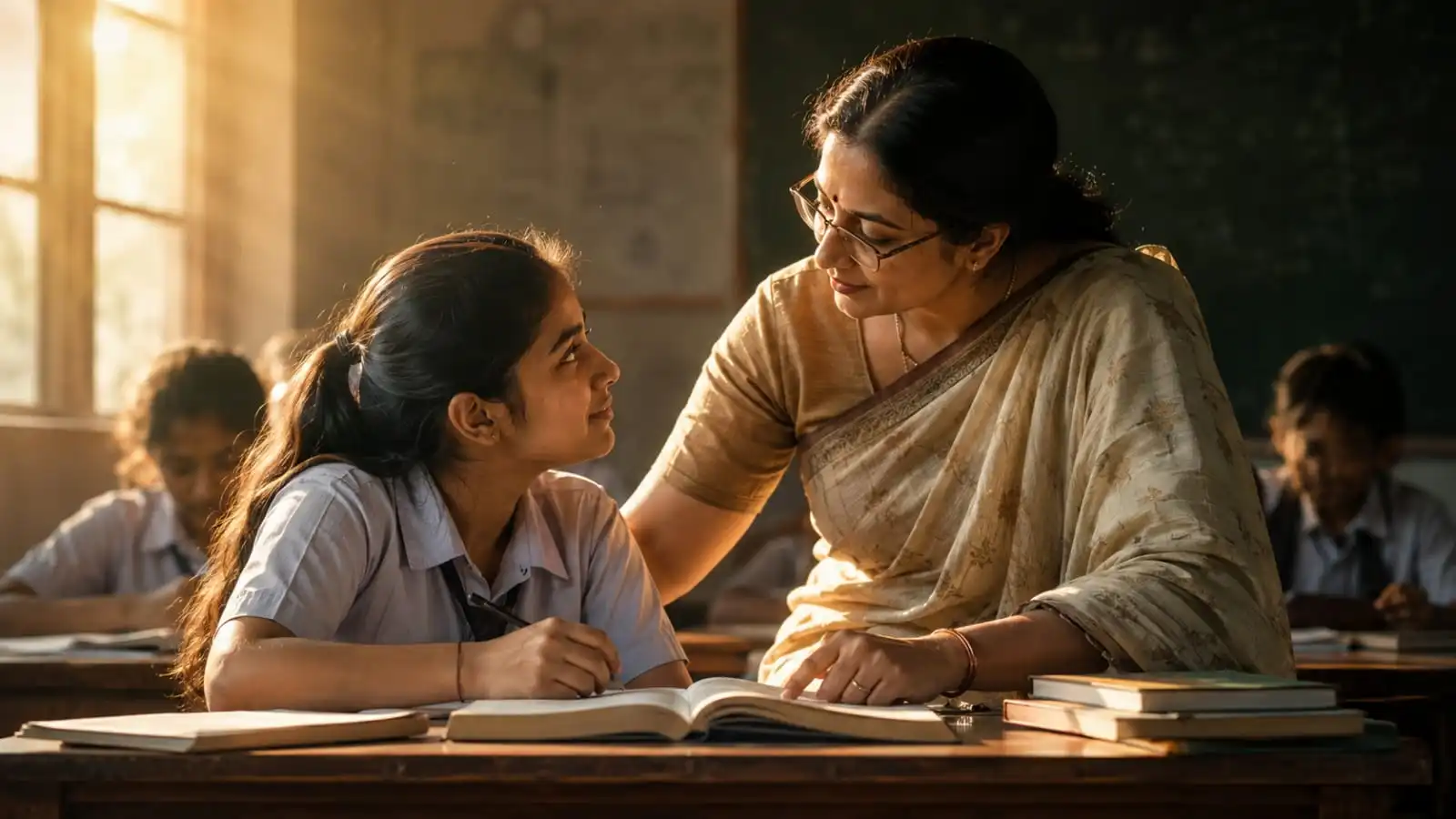
When we think about teachers, we often think about classrooms, lectures, assignments, examinations and grades. We associate teaching with knowledge and academic success. But as students, we eventually realise that a teacher’s role goes far beyond what is written in a syllabus.
A teacher may enter our lives as someone who teaches us a subject, but over time, they can become someone who teaches us how to navigate life.
There is something I once heard about the relationship between a guru and a student that has stayed with me. If you truly want to receive knowledge from a guru, you must sit in their presence. When the guru sits above and the student sits at their feet, knowledge is believed to flow from the guru towards the student, just as light travels from above to below.
I find this idea beautiful because learning is not simply about receiving information. It is also about being in the presence of someone whose experience, wisdom and perspective can illuminate our own path.
Perhaps this is why some of the most important conversations students have with their teachers have nothing to do with academics.
There are things we sometimes cannot tell our parents. It may be the fear of failing, confusion about a career, pressure from expectations, a personal struggle, or simply the feeling of being lost. Sometimes, talking to a teacher feels easier because a teacher can listen from a different perspective. They may not have an immediate solution, but they can give us the space to speak, think and understand what we are going through.
And sometimes, that is exactly what a student needs.
A good teacher does not see a student merely as a mark sheet. Every classroom has students with different abilities, backgrounds, personalities and struggles. Some speak confidently, while others take time to find their voice. Some excel academically, while others discover their strengths elsewhere.
A teacher who recognises this understands that education is not about making every student the same; it is about helping each student discover what they can become.
The impact of such teachers often stays with us much longer than we realise. We may forget a particular lecture or the details of an assignment, but we remember the teacher who encouraged us after failure, believed in us when we doubted ourselves, or simply listened when we needed someone to listen.
A recent incident from Nepal made me think about this responsibility in an entirely different way. During the devastating flash floods, headteacher Rajendra Dawadi of Tribhuvan Trishuli Secondary School acted within minutes after receiving warnings of the approaching flood. He ordered the evacuation of the students and helped move around 900 children and staff members to safety, just before the school was destroyed by the floodwaters.
In that moment, he was not simply a teacher managing a school. He was someone responsible for the lives of the children entrusted to his care. It is a powerful reminder that a teacher’s responsibility can extend far beyond lessons, examinations and classrooms.
Today, this role is becoming even more meaningful because the world around education is changing rapidly. Artificial intelligence, chatbots and new technologies are changing the way students learn and access information. We can find answers within seconds, but information alone cannot teach us judgement, empathy, values, or how to make the right choices.
Technology can give us an answer. A teacher can help us understand which questions are worth asking.
Perhaps that is why teachers will remain important even as education changes. Their role may evolve, but the need for human guidance will not disappear. In fact, in a world overflowing with information, having someone who can help us make sense of it may become even more valuable.
Teachers also teach us things that cannot be measured through examinations. They teach us discipline, kindness, equality, curiosity and the courage to keep learning. Their influence can be seen in the confidence of a student who once felt inadequate, in someone who finds the courage to try again after failure, and in the choices a young person makes years after leaving college.
A teacher spends years preparing students to eventually move beyond the classroom. Yet, in the process, they become a part of the people those students become.
Maybe that is the most beautiful paradox of teaching.
Teachers give us knowledge so that we can find our own way, guidance so that we can make our own decisions, and confidence so that one day we can stand on our own. And long after we leave their classrooms, something of them continues to travel with us.
Education may begin with books, but its deepest lessons often begin with people.
And perhaps, on Teachers’ Day, what we really need to celebrate is not only what our teachers taught us, but also who they helped us become.