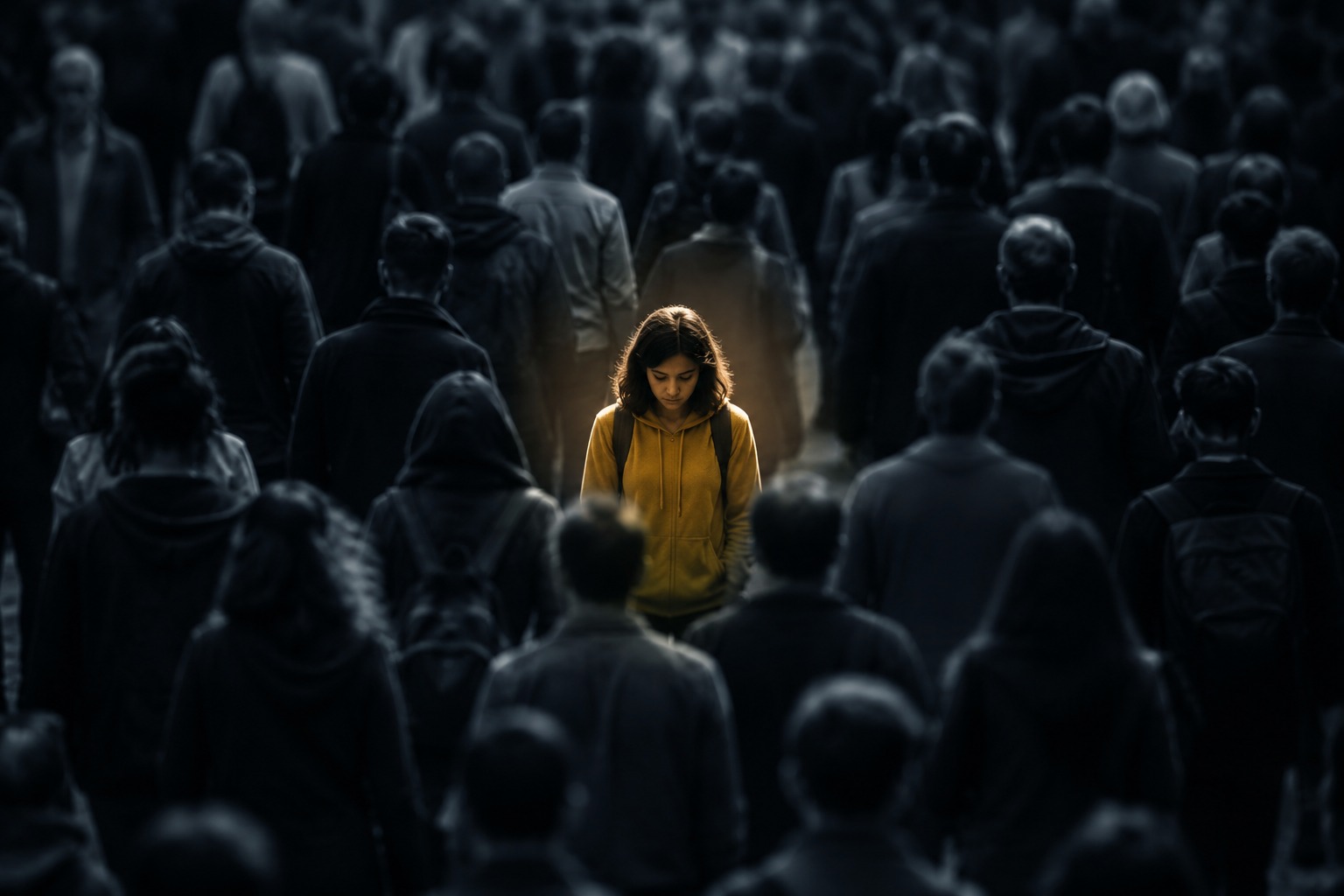
In a Country of 1.4 Billion People, Why Do So Many Still Feel Lonely?
- |
- 25 Jul 2026
- |
- Connected minds

Last week, I found myself sitting alone in a crowded café.
Around me, life was unfolding in the most ordinary ways.
A group of college students burst into laughter over something only they understood. Two elderly friends sat quietly, sipping tea, comfortable in a silence built over decades. A mother tried to feed her toddler between bites of her own meal. At another table, a young couple sat together but not with each other. Both were staring at their phones, occasionally looking up, only to return to their screens.
The café was alive.
There were conversations, laughter, ringing phones, the clinking of cups, and the aroma of freshly brewed coffee.
There was everything that makes a place feel full.
And yet, as I looked around, a question refused to leave me.
How many of these people feel truly seen?
Not noticed.
Not followed.
Not spoken to.
But genuinely seen.
How many are carrying worries they have never put into words?
How many smiled before leaving home because they didn’t want anyone asking uncomfortable questions?
How many will return tonight to homes filled with family members, only to lie awake feeling that nobody really understands what they are going through?
We often imagine loneliness as an empty room, an elderly person living by themselves, or someone who has no friends.
But what if loneliness doesn’t look like that at all?
What if loneliness is sitting at a dining table with your family while feeling that you cannot share what is breaking you inside?
What if it is being surrounded by people every single day and still feeling emotionally invisible?
That afternoon, I realised something. Perhaps loneliness has never been about being alone. Perhaps it has always been about feeling alone.
The loneliness we don’t recognize
When people hear the word loneliness, they often think of isolation. Psychology, however, describes loneliness very differently.
Loneliness is the distress we experience when the relationships we have don’t match the emotional connection we need. In simple words, you can be surrounded by people and still feel profoundly lonely if you don’t feel understood, accepted or emotionally safe.
This explains why loneliness does not discriminate.
It affects the college student living in a hostel. The entrepreneur surrounded by employees. The homemaker whose entire day revolves around caring for others. The senior executive leading a team of hundreds. The retired parent waiting for a phone call from their children. The teenager who has thousands of followers online but nobody they feel comfortable calling at midnight.
Different lives.
Different ages.
The same emotional experience.
The Indian paradox
India has always been a country built around relationships. We celebrate together. We mourn together. We eat together. Our festivals fill entire neighbourhoods with colour. Weddings become community events. Relatives arrive unannounced. Neighbours often know our stories without us telling them.
For generations, this sense of community became an invisible safety net for emotional well-being. If someone disappeared from the neighbourhood for a few days, people noticed. If a family faced difficulty, others stepped in. If someone lost a loved one, grief was shared.
Our relationships were imperfect, but they were present. Today, many of those structures are quietly changing. Young adults leave home for education and work. Joint families are becoming nuclear families. Many older parents live in one city while their children build lives in another city or another country.
Neighbours sometimes don’t know each other’s names. Children spend more time on screens than in playgrounds. Life has become more efficient. But efficiency is not the same as connection.
We have never communicated this much and perhaps never listened this little.
Think about the average day. We respond to dozens of WhatsApp messages. Attend meetings. Scroll through Instagram. React to stories. Like photographs. Reply with emojis. Forward birthday wishes. Video call relatives. From the outside, it looks like we are constantly connected.
But somewhere along the way, communication quietly replaced conversation. We know what restaurant our friends visited. We know whose promotion was announced on LinkedIn. We know who travelled to Goa. But do we know who is struggling with anxiety? Who cried themselves to sleep last week? Who has been pretending to be okay because they don’t want to worry their parents? Information has increased. Understanding has not necessarily grown with it.
The pressure to look okay
Another reason loneliness has become so common is that many people no longer feel safe showing their emotional reality. From childhood, many of us hear messages like:
“Be strong.”
“Don’t overthink.”
“Move on.”
“Everyone has problems.”
Slowly, we learn something dangerous. We learn that difficult emotions should be hidden. So, we become experts at functioning. We go to work. We attend family functions. We laugh at jokes. We post photographs. We congratulate others. And somewhere behind that carefully managed life, a quiet loneliness begins to grow. Not because nobody loves us. But because very few people know the real version of us.
Loneliness is not solved by more people.
It is solved by safer people. People who listen without immediately offering advice. People who allow silence without becoming uncomfortable. People who ask a second question after hearing, “I’m fine.” People with whom we don’t have to perform.
Think about the people who have made you feel most at peace. Chances are, it wasn’t because they had the perfect words. It was because you never felt judged in their presence. Psychological safety is one of the most underrated forms of emotional support. Sometimes healing begins simply because someone stayed.
Mental health is built in everyday moments
When we think about mental health, we often think about therapy, medication or counselling. All of these are incredibly valuable. But mental health is also built in the ordinary moments that rarely make headlines.
A friend who notices you’ve become quieter than usual. A colleague who says, “Let’s go for a walk.” Parents who listen without immediately correcting. Children who spend ten uninterrupted minutes talking to their grandparents. Neighbours checking on someone who hasn’t stepped outside for a few days.
Communities, where asking for help is seen as courage, not weakness. These moments rarely go viral. Yet they quietly protect mental health every single day.
Maybe India doesn’t need more connections.
Maybe it needs deeper ones. Perhaps the answer to loneliness is not creating another social media platform. Perhaps it is putting our phones away during dinner. Calling the friend, we’ve been meaning to call for months. Listening without trying to fix.
Checking on the colleague who suddenly became unusually silent. Creating homes where people can speak honestly without fearing judgment. Building workplaces where vulnerability isn’t mistaken for incompetence. Creating communities where people feel they belong before they feel they have to prove themselves. Because belonging is one of the deepest human needs. And when people feel that they belong, they are less likely to suffer in silence.
One question that can change everything
As I left that café, the crowd hadn’t changed. The conversations were still happening. People were still laughing. Coffee was still being served. Everything looked exactly the same. Except my perspective. I realised that every person I had seen that afternoon was carrying a story I knew nothing about.
A dream.
A fear.
A heartbreak.
A loss.
A silent battle.
Perhaps the greatest act of kindness today isn’t giving people advice. It is giving them the space to be real. So, before we ask ourselves how many followers we have, how many contacts are saved in our phones, or how many people attended our last celebration, maybe we should ask a different question.
Who in my life knows the real me?
And equally important…
Whose safe place, am I?
Because loneliness does not disappear when we enter a crowded room. It begins to fade when even one person makes us feel seen, heard and accepted.
In a country that has always celebrated relationships, perhaps the future of mental well-being is not simply helping people find support. It is helping people find each other again.